


2026 personal income tax reform: what will actually change for you?
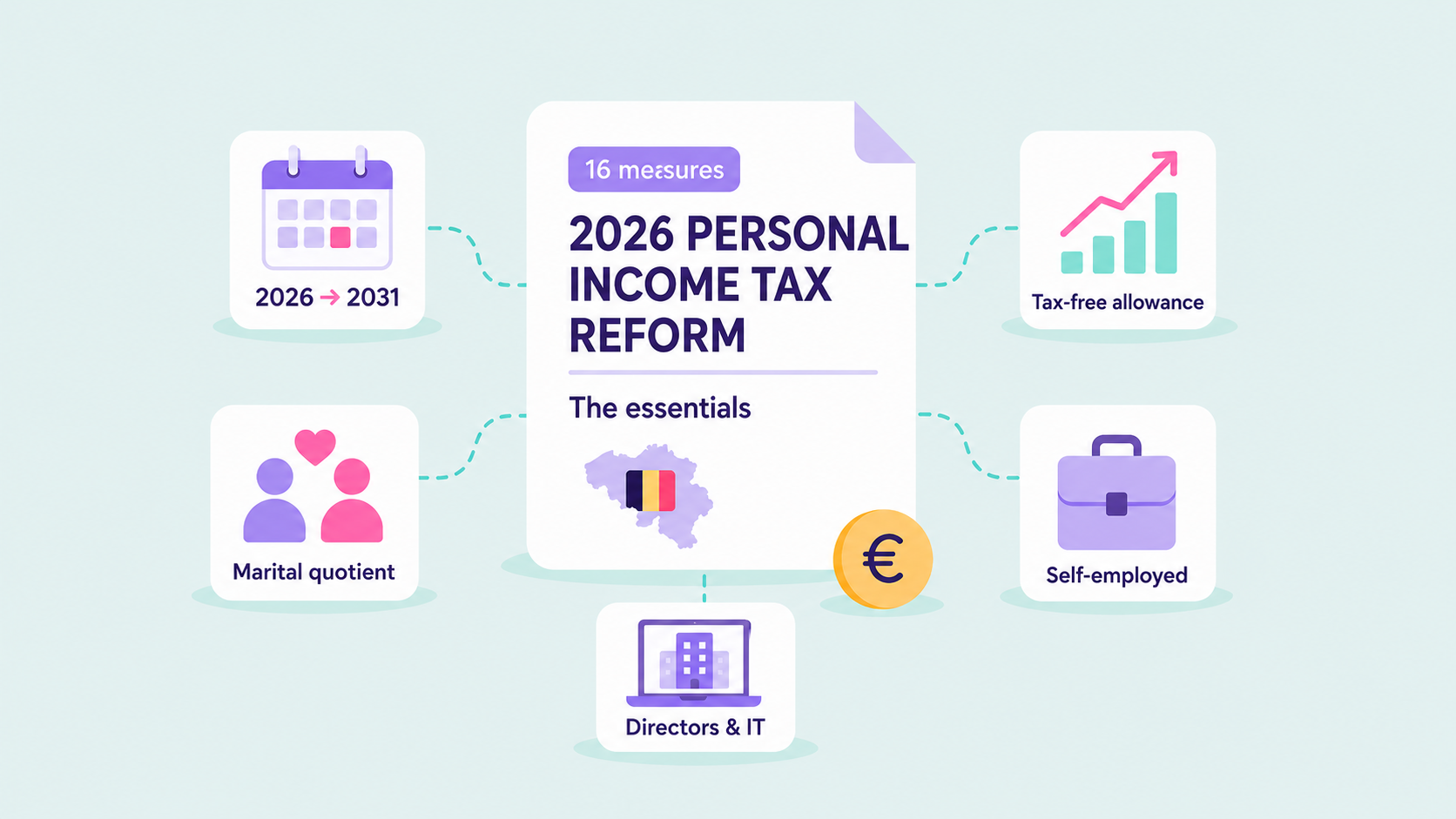
The first part of the personal income tax reform contains sixteen measures and several transitional regimes, the effects of which will be spread over several assessment years. It will therefore not generate the same benefit for everyone. Two taxpayers with comparable incomes may be affected very differently depending on their family situation and the way in which they carry out their professional activity.
The increase in the tax-free allowance will benefit a large part of the population, but it comes with a gradual reduction of the marital quotient, stricter rules for company directors and the gradual abolition of several tax advantages. Conversely, self-employed individuals operating in their own name and certain professionals in the IT sector will benefit from new favourable measures.
The reform therefore cannot be assessed on the basis of an average tax benefit: what matters is how it affects your particular situation, assessment year by assessment year. This article reviews the main measures, grouped according to the taxpayers concerned and the decisions they may require, based on the bill adopted by the Chamber of Representatives.
AT THIS STAGE
The bill has been adopted by the Chamber of Representatives, but certain provisions still need to be published in the Belgian Official Gazette or clarified by Royal Decree. The measures described below should therefore be read subject to this reservation.
What is the reform trying to achieve?
Before looking at the details, it is useful to understand the overall logic of the reform, as this helps explain each of the measures.
The reform's first objective is to increase net income from work, in particular by raising the tax-free allowance and strengthening the employment bonus.
At the same time, it reduces certain benefits linked to household composition or replacement income, such as the marital quotient and the tax reductions granted to recipients of unemployment benefits.
Finally, it further differentiates the tax treatment of self-employed individuals operating in their own name and company directors. The former benefit from new favourable measures, while the latter will be subject to stricter conditions. Depending on your profile, you will mainly be affected by one or the other of these developments.
What changes for most taxpayers?
The tax-free allowance will increase until 2031
The central measure is the increase in the tax-free allowance, meaning the first portion of income on which no tax is due. Its basic amount, before indexation, will increase from EUR 4,785 to EUR 6,230 between assessment years 2027 and 2031. After indexation, the target amount reaches EUR 14,450 for assessment year 2030 and then EUR 15,600 for assessment year 2031, although the latter amount still needs to be confirmed by the next government. The benefit should gradually be reflected in monthly net income as the calculation of payroll withholding tax is adapted by Royal Decree.
One qualification should nevertheless be noted. The benefit is mainly aimed at professional income. For pensions and replacement income, its effect will largely be neutralised by adjustments to the corresponding tax reductions.
The employment bonus and the special social security contribution
Lower employment income will benefit from a second measure. The employment tax bonus will be strengthened for low salaries, in line with the increases in the minimum income in 2026 and 2028. The special social security contribution will also be individualised and its rates revised, potentially reducing its maximum burden by half. The stated aim is to reduce the so-called promotion trap affecting couples in which both partners work.
Dependent children
Families with one or two children will see their tax advantage increase. By assessment year 2029, the additional tax-free allowance for the first child will be aligned with that of the second child, at EUR 2,650 before indexation.
The benefit will, however, be less pronounced for larger families. The additional allowances granted from the third child onwards will not be indexed for income years 2026 to 2029. Nevertheless, the increase in the basic tax-free allowance should still result in a positive net effect for most of these families.
Households that may lose part of their tax advantages
The marital quotient
The marital quotient allows part of one partner's income to be notionally allocated to the other partner when the latter has little or no income, up to a capped amount of 30 percent. Its gradual abolition represents the most significant downside of the reform for single-income households.
The gradual phase-out of the marital quotient will be implemented by reducing its ceiling, rather than by lowering the 30 percent percentage itself. This distinction is essential when assessing the actual tax loss. The ceiling, set at a basic amount of EUR 6,700, or EUR 13,490 after indexation for assessment year 2026, will be reduced by half between assessment years 2027 and 2030 and will cease to be indexed from 2027 onwards. Several summaries have presented a different timetable, often referring to 2029. It is in fact assessment year 2030 that marks the end of the reduction. For couples where both partners have reached the statutory retirement age, the phase-out is significantly slower and extends until assessment year 2046.
The actual loss will nevertheless be more limited than the reduction of the ceiling alone might suggest. The mechanism allowing the tax-free allowance to be transferred between spouses in the case of joint taxation is maintained, while the increase in the basic tax-free allowance benefits both partners. The net effect will therefore depend on how income is distributed within the couple and will need to be assessed year by year.
THE PRACTICAL ISSUE
The reduction of the marital quotient will not result in a tax loss equivalent to the reduction of its ceiling. The higher tax-free allowance and the possibility of transferring it between spouses may absorb part of the impact. For single-income households, a projection through to assessment year 2031 will make it possible to distinguish the theoretical loss from the actual tax effect. The key variables are each spouse's income, the presence of dependent children, the relevant assessment year and the partners' ages.
Single parents, unemployment and pensions
Other tax benefits will also be tightened under the same logic. From assessment year 2030, the additional tax-free allowance for single parents will be reserved for parents who are genuinely living alone, meaning that, on 1 January, their household includes no other persons apart from their children and certain close relatives. The additional allowance for low-income single persons will remain available and may still be converted into a tax credit. The tax reduction for unemployment benefits will gradually be abolished: it will be reduced to one quarter from income year 2026 before being abolished altogether, subject to a transitional regime for single parents with one or two children.
Pensioners will be affected in two ways. The tax reduction for pensions will disappear above taxable income of approximately EUR 70,570. In addition, from 2027, pensioners who continue to work as employees after completing a full career will be subject to a separate 33 percent tax on that remuneration, without any restriction as to the nature of the work or the amount earned.
Self-employed individual or company director: two different tax paths
This is arguably the clearest contrast within the reform. It introduces two new advantages for self-employed individuals operating in their own name, while imposing several stricter conditions on company directors. The same legislation therefore pushes the two statuses in opposite directions, which is far from neutral for anyone still deciding whether to operate in their own name or through a company.
Self-employed individuals operating in their own name: two new opportunities
Self-employed individuals will first benefit from a new deduction. It is reserved for taxpayers whose income consists of business profits or professional proceeds and therefore, by definition, excludes company directors, whose income is taxed as directors' remuneration. Applicable from income year 2027, it exempts an initial portion of profits, with an indexed amount of approximately EUR 620, which is expected to increase thereafter.
More significant in practice is the abolition, from income year 2026, of the tax increase for insufficient advance tax payments, specifically for self-employed individuals operating in their own name and assisting spouses. Companies and company directors are not covered by this measure. This abolition does not mean that advance payments should necessarily be stopped: the tax credit for making advance payments remains available, and making them continues to be a cash-flow management decision, balancing retained liquidity against the tax reduction obtained. A self-employed person who decides to stop making advance payments will nevertheless need to retain sufficient liquidity to pay the tax when it ultimately becomes due, so that a payment deferral does not turn into a liquidity problem.
Company directors: remuneration needs to be reconsidered
To retain the reduced corporate income tax rate, certain small companies will now have to grant at least one company director minimum remuneration of EUR 50,000, unless their taxable profit remains below this amount. Companies that were only slightly above the previous threshold will therefore need to reconsider their remuneration policy.
Increasing remuneration is not necessarily the most advantageous solution, however. The additional personal income tax and social security contribution costs must be compared with the tax saving achieved by the company through continued access to the reduced corporate tax rate. The analysis should cover the director's entire remuneration package: cash remuneration, benefits in kind, dividends, pension commitments and expense reimbursements.
The reform also aims to limit the proportion of lump-sum benefits in kind relative to gross remuneration. The measure primarily concerns company directors who receive relatively low cash remuneration supplemented by a company car, housing, payment of private expenses or a loan at a favourable interest rate. The principle of the restriction appears to be established. Its tax base and exact mechanism will nevertheless need to be confirmed based on the text published in the Belgian Official Gazette. It would therefore be premature to revise existing remuneration packages solely on the basis of the initial commentaries.
THE DECISION THAT NEEDS TO BE PREPARED
Affected company directors will need to verify whether their remuneration meets the new threshold and assess the proportion represented by their lump-sum benefits in kind. The aim is not simply to comply with a condition but to determine the most appropriate combination of remuneration from a tax, social security and financial perspective. This analysis requires knowledge of the company's taxable profit, the director's marginal tax rate, their social security contributions and the forms of remuneration already in place.
The return of copyright income for the IT sector
One of the most eagerly awaited measures is the reopening of the copyright tax regime to software developers, who had been excluded from the regime since 2022. Income paid or attributed from 1 January 2026 onwards will once again be eligible: code, scripts and software modules may once again give rise to remuneration taxed as movable income.
However, the regime is not being restored in exactly the same form. The simultaneous abolition of the flat-rate expense deduction increases the effective tax rate from approximately 7.5 percent to 15 percent. The tax advantage is therefore significantly lower than it was before 2022, although it remains meaningful compared with remuneration taxed at the marginal personal income tax rate.
Most importantly, a developer's eligibility does not mean that their entire remuneration can be converted into copyright income. It is still necessary to identify a genuinely protected work, organise its assignment or licensing, document the corresponding remuneration and comply with the limits inherited from 2022: an absolute limit of approximately EUR 77,000, a relative limit of 30 percent of remuneration and an average assessed over a four-year period. One final point deserves attention: the social security treatment has not been amended, meaning that copyright income relating to software remains excluded from the exemption from social security contributions. The tax and social security treatment therefore no longer coincide, and any agreement should be reviewed from both perspectives.
What should you do now?
No decision should be based on an announced average benefit, as such an average covers situations that are too diverse to serve as a meaningful individual benchmark. The first step is to identify, among the sixteen measures, those that actually apply to your situation and then assess their combined effect over several assessment years. Most measures will be phased in until 2031, and a year-by-year analysis reveals trajectories that are hidden by an average.
Some restructuring decisions would also benefit from being postponed. Until the implementing Royal Decrees and the text published in the Belgian Official Gazette are available, it would be premature to alter a remuneration package or stop making advance tax payments solely on the basis of the summaries currently available. The reform should therefore be anticipated now, but irreversible decisions should preferably only be taken once the legal and regulatory framework has become sufficiently stable.
In 30 seconds
✅ Reform adopted on 10 July 2026, still to be published in the Belgian Official Gazette, with effects phased in from 2026 to 2031
✅ Tax-free allowance increased to EUR 14,450 for assessment year 2030 and then EUR 15,600 for assessment year 2031
✅ Marital quotient: ceiling reduced by half between 2027 and 2030, with part of the impact mitigated by the transfer of the tax-free allowance between spouses
✅ Self-employed individuals operating in their own name: new deduction and abolition of the tax increase for insufficient advance tax payments
✅ Company directors: minimum remuneration increased to EUR 50,000 and tighter rules for lump-sum benefits in kind
✅ IT sector: copyright regime reopened, but with a significantly reduced tax advantage
✅ Unemployment and single-parent benefits tightened, while the pension tax reduction is abolished above approximately EUR 70,570
✅ Do not make decisions based on an average tax benefit: analyse the reform measure by measure and assessment year by assessment year